From December — in favor of a primary

The first week of the campaign to be the next US Senator from Massachusetts is drawing to a close.  Three dramas remain.  The first is Governor Patrick’s selection of an interim senator.  The second is Senator Brown’s decision as to whether to seek the seat, and the third is the Democratic primary battle.  I want to touch briefly on the first two dramas and then talk about the third at greater length.  My theme here is straightforward:  I think that we need to stop looking for outsiders to ride in on horseback and save us (Ted Kennedy, Jr., Ben Affleck) and start looking at public servants who want the opportunity to do more for the community (Mike Capuano, Ben Downing, Ed Markey . . ).  Here in Massachusetts, we will have an opportunity to select a Senator based on a career of service rather than their personal wealth.

I have said and written that I think that Governor Patrick should appoint Mike Dukakis to the interim senate role.  I would also be pleased were he to ask Barney Frank to spend a few more months in Washington.  Either choice would call on a man who has given his life to public service and not to personal profit.  In announcing the selection, the Governor could remind all of us of the nobility of such a life and of the value it has for the community.  If the world becomes one where businesspeople can expect to transition to high political office, the quality of people who choose to serve in lower political office will suffer.  If the fiscal cliff nonsense teaches anything, it is that we need to revise our system so that our best people think of politics as a viable pursuit from the outset.

With respect to the Republicans, I hope Scott Brown chooses to run.  While I do not support the Senator, I admire his career in public service.  He took the right route to political power — serving in the State House and running campaigns based on his ability to talk with and connect with voters.  If he chooses not to run, I worry that the Republicans will nominate Bill Weld, whose return to Massachusetts feels like political opportunism.  It is impossible to believe that Weld came home because he felt compelled to represent the people of the Commonwealth in some capacity.  He couldn’t even manage to maintain focus on that goal while he was our Governor.  Said differently, I like what Scott Brown represents, even if I don’t want him to represent me.

So, that brings me to the Democrats.  I hate the romance with outsiders without political experience.  How can it be that the right choice for the Senate is someone who has never held office or played any role in government?  Elizabeth Warren and Deval Patrick both exercised significant public responsibility before they sought elective office.  Ted Kennedy, Jr. and Ben Affleck??  Not so much.  Nevertheless reporters suggest state party folks wanted one of the two of them to run and thereby “clear the field” so that there would not be a damaging primary battle.  “Clearing the field’ is some concept.  It suggests that a candidate with name recognition and the ability to raise money nationally will keep out other candidates and thereby let the party focus on beating the GOP candidate from day 1.  Elizabeth Warren was such a candidate.  With Kennedy and Affleck out, the Democrats are without such a candidate now (although a decision by either Vicki Kennedy or Governor Patrick to run could change that).  As a consequence, a primary looms.

That’s as it should be.  The people running or thinking of running include:  Ed Markey; Mike Capuano; Steve Lynch; Ben Downing; and Niki Tsongas.  All of these folks have devoted their professional lives to public service.  Each apparently perceives an opportunity to do more to advance their policy agendas in the US Senate than in their current office.  Each deserves the chance to make their case to the people of the Commonwealth.  Whatever else you may think of them, the choices they have made with their lives entitle them to our serious consideration.

We are rightfully disappointed with our government now.  But, as our Governor reminds us again and again, we get the government we deserve.  We need leaders who have worked their way through the political system and who understand it well enough to do good.  We need leaders who are devoted enough to public service to want to devote their lives to it.  And we need a system that rewards them with the opportunity to advance if they do their jobs well.  That’s not about “field clearing,”  It is about hard work, hopes and dreams.  A lot depends on making sure that we still raise children who dream of political leadership and that we make clear that those dreams can be fulfilled through hard work and dedication.  All three of the current Senate-related dramas offer the opportunity to convey this message.  Let’s do it.
Posted in Last year's blog | Leave a comment

Obama and King: Thoughts for Today and Tomorrow

Today, all across the country, we observe a holiday in honor of Dr. Martin Luther King, Jr.  In our schools, children are introduced to, or reminded of, his life.  Inevitably, radios play the words of his “I Have a Dream” speech on the Washington Mall in March of 1963.  For many of us, thanks to education and the smoothing effect of time, that speech defines who he was and makes him, comfortably, a hero.  It was certainly how I viewed Dr. King when, as a student at Swarthmore College in the Fall of 1985, I walked into a classroom and met Vincent Harding.  Vincent was, at the time, a visiting professor at the college.  Long before that, he had worked closely with Dr. King.  Professor Harding brought all of the students assembled, in the safety and comfort of a small liberal arts college, face to face with the last years of Dr. King’s life, with his calls for a “Poor People’s Campaign,” and with his calls for revolutionary change rather than a comfortable march to the mountaintop.

Four years ago, on the occasion of the swearing in of Barack Hussein Obama as President of the United States, it seemed as though we, as a people, had fulfilled Dr. King’s dream of March 1963.  Our President was a person of color.  His children, like children of color all over the country, lived as equals with the children of white people.  King’s words now sounded like a clarion over the space of time — reminding us of where we had been and giving us room, comfortably, to celebrate where we had arrived.  The celebration of Obama’s first inaugural was a hopeful time.  As a country, we joined hands, we heard Aretha sing and we looked forward.

Vincent Harding would not let us smooth over Dr. King.  He wanted us to understand that   Dr. King’s ministry wasn’t about holding hands and singing.  He wanted us to hear the words of the older, though not very old, King:  “Our only hope . . . lies in our ability to recapture the revolutionary spirit [of America] and go out into a sometimes hostile world declaring eternal hostility to poverty, racism, and militarism.”  King traveled to Memphis to fight poverty.  His battle ended there.  And, with the passage of time, and the need to glorify him, so too did our collective memory of what he sought.  Today, it seems to me, is the right time to fix that.  It is time for us to remember and to act.

On the occasion of the President’s second inaugural, let’s focus on the problems that drew King’s attention after March of 1963.  The gap between rich and poor has never been greater.  Our country has been at war for as long as any of us can remember.  Our collective economic fortune has suffered both as a consequence of these wars and of our inability to create opportunity for those with less to succeed.  The challenges the President faces are so great that they are vividly clear on his aging and worried face.  But these are our challenges.  And, on this day, we must remember that no one man, neither a President nor a long dead hero, can fix them alone.

Vincent Harding writes: “Somewhere . . . this encouraging, disciplining promise stands forth: ‘When the student is ready, the teacher will appear.’”  It is not too much to say that we were, at Swarthmore in 1985, ready for Vincent Harding.  The question today is whether Barack Obama and, by extension the country, is ready for Martin King in January 2013.  There are signs that we are:  the President is pushing for meaningful gun control and is committed to withdrawing our troops from Afghanistan (militarism); he is committed to marriage equality (combatting hatred); and he has passed meaningful health care change and is grappling with immigration reform (poverty).  At the same time, there is still a long way to go.  Challenges and opportunities travel together.  This second term is an opportunity for all of us.   I like to think that we are students and that we are ready now for the teachings of Dr. King.  Today, we celebrate; tomorrow, we get to work.

For those interested:  http://www.amazon.com/Martin-Luther-King-Inconvenient-Hero/dp/1570757364/ref=sr_1_3?s=books&ie=UTF8&qid=1358779029&sr=1-3&keywords=vincent+harding

Posted in 2013 Blog | Tagged , , , | 1 Comment

Radio segments

image

Selected Radio Segments

Here is selected audio from my radio appearances —

Posted in RADIO SEGMENTS | Tagged , , , | Leave a comment

The Athenian Pledge

This is a good week for those of us who think in terms of generational responsibility.  When Mike Dukakis accepted the Democratic nomination for President in 1988, he quoted the Athenian marathon pledge at the conclusion of his speech.  He told us that the pledge ends:  “Thus, in all these ways, we will transmit the country greater, stronger, prouder and more beautiful than it was when it was transmitted to us.”  I remember thinking then that he had found words that almost precisely described the duty of each generation and, accordingly, the duty of our government.  And I can say with confidence that there have been few occasions since when I have felt that our leaders were attentive to this obligation or that we were together on the verge of making the kinds of decisions that would fulfill our responsibilities to those who are not yet here.  This week is one of those occasions and that is reason for reflection and celebration.

Our current governor, Deval Patrick, committed to all of us that he would serve out his second term.  In his State of the State address this week, he made clear how serious he is about making the next two years count.  He wants to change the way our Commonwealth works.  He wants to make certain that the quality of opportunity our kids have does not depend on where they happen to be born.  He wants our educational system to deliver that opportunity to all of the children of Massachusetts, and he is prepared to make that happen.

He also wants to build a public transportation system for the whole state.  We should, he thinks, all be connected by rail and other means.  That system, he reasons, will improve our economy and thus our collective future.  It will, I think, further unite our state and better spread the opportunities that flow from the wisdom and innovation that helped us escape the Great Recession faster than other states and that assure that Massachusetts will always be one of the best places to live in the country.

Think about what those twin efforts promise: better opportunity for our children — meaning that simply being from here will mean that a child’s education will prepare them to tackle the challenges of adulthood; and more widespread commerce — meaning that many of the great parts of this state, Worcester, Springfield, Pittsfield and more, will be accessible to all of us.  Fulfilling this promise will cost money, and the Governor is asking us to pay for it.  He suggests an increased income tax, a decreased sales tax, and the elimination of many deductions.  The resulting tax system will not only pay for the changes he seeks, but also be more fair in that it will call on people with more to bear more of the burden.

I am certain that this will spark outrage, but I urge you to hold your anger.  Think instead of what is possible.  Isn’t it right that every child in our state deserves the opportunity created by education?  Our history has been about one generation standing on the shoulders of the one that came before and building something better.  Sadly, our generation’s shoulders have seemed weak.  We have too often been concerned with now, unwilling to think about what will come next.  Now is the time to let yourself dream with our Governor.  Talking about what’s possible is the consistent poetry of our politics (“yes we can”).  Actually standing up and saying let’s do the work necessary to make what’s possible real is what government should be, but almost never is, about.  This is one of those rare moments; let’s seize it.

Listening to Governor Patrick, I felt proud to be a citizen of the Commonwealth.  I want to live in a world where our leaders focus on what we can do to be better and not merely enumerating the things that are wrong.  If you take the time to read his speech, look closely at his plans, and notice that he is ready to pay for the change he wants, I think you will see why so many of us have been enthusiastic about Deval Patrick for so long.  No one doubts the power of his poetry.  This week should end any doubts about his will to govern.

Posted in 2013 Blog | Tagged , , , | 3 Comments

Talk Radio in Boston

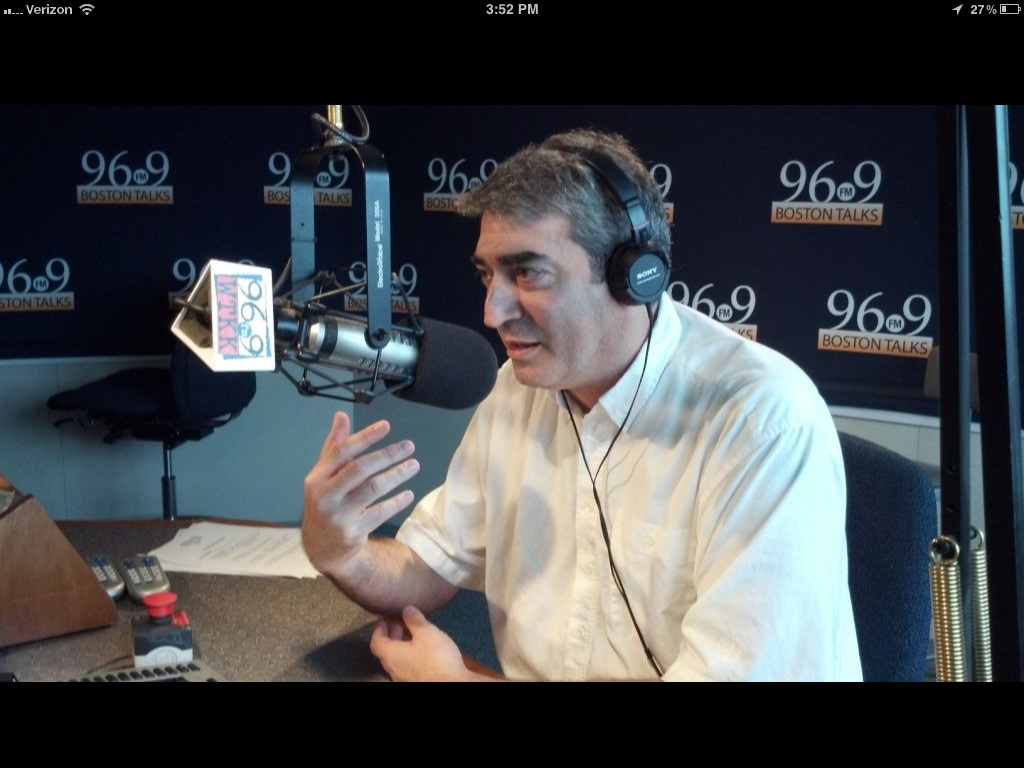
Over the past year, I have spent several hours a week talking on the radio in Boston.  Beginning in August, I hosted a two-hour program every Sunday night from 7-9pm on what used to be NewsTalk 96.9.  Guests — from the Globe’s Glen Johnson to former Channel 5 weatherman Dick Albert to the Dean of Admissions at Swarthmore College — joined me and helped in my weekly quest to make a little more sense of our world.  In addition, I had the good fortune to fill-in for Jim Braude on the Jim & Margery show (Margery Eagan is really smart), for Doug Meehan and for Hank Morse.  I also joined Michael Graham and others for election night coverage — trying to make sense of returns through our respective partisan lenses.  Everything I saw made me think that talk radio is a vital and important medium.  So, consider this not an obituary for the now-gone station as much as a challenge to others to fill the vacuum left by its demise.

In the Boston Herald, Howie Carr argued that the station died because it failed to persuade the courts to let him work there.  He is absolutely not right.  His further diagnosis, that the station had become “Moonbat Radio” is similar nonsense.  If there was a problem with the programming at 96.9FM it was that it lacked coherence.  A listener could not be sure exactly what he or she would encounter when tuning in.  You can’t say that about WRKO.  Howie’s world of conservative angry talk still has a place.  My view is that that’s the kind of talk radio that’s dead or dying.  We don’t need a constant stream of anger and complaint.  Nothing comes of that — and we have much still to hope for together.

We live in a vibrant city.  Here, we take ideas seriously.  Talk radio that does the same has a place in the city and it does not have to be crazy right wing to succeed.  For me, one of the lessons of my time on the air was the wisdom of the callers.  Sure, there were calls from people who were driven by agenda rather than reason (did I know how many babies die every year?  why did I hate guns?  had I ever read the constitution?).  But there were also callers whose ideas turned or focused our conversation (I remember a caller who talked about the value of his vocational education).  Every time I left the station, I felt that I had learned something that mattered from someone who had taken the time to call the show.

If you go see the Huntington Theater’s production of  “Our Town,” you get the sense of being part of a small town gathering.  The other people in the theater are strangers, but you are connected by the common experience of the show, by your individual decisions to attend.  So too with a good talk radio show.  And the conversation that happens — about Elizabeth Warren, the value of a college education, a coming storm — is the stuff of our community.  By meeting together, with a facilitator (host) at the center, we help figure out what it means to live together in this part of the world at this point in the century.  Sports radio does that for our local teams.  Talk radio done right can do that for our city.

NPR goes part of the way, but it does not offer enough room for conversation from its listeners.  And we need to hear from the people who listen to NPR.  They have lots of intellect, lots of opinions, and not enough programs that reach out to them and seek their participation.  My talk radio notion is that the radio can be the place where the community gathers to talk and to listen to one another.  We have had glimpses of it here — David Brudnoy, Larry Glick, and Chris Lydon.   We need more.  We need hosts who will take the time to help make sense of complicated news and then lead a conversation that solicits and values the thinking of the audience.  We need interviews that lead us to think and understand more about the world than we did when the show started.  And we need hosts with the political courage to take a position (left or right) and tolerate and try to make sense of views that differ.

When that happened on WTKK, it was terrific stuff.  A station with the courage of its convictions can make that happen here in Boston.  How great would it be to get in the car and know that somewhere on the radio was a conversation characterized by energy and intelligence?  A place where you might listen, learn and laugh a little.  From its beginnings until right now, this City has been a thoughtful place.  We deserve radio that reflects this essential aspect of our character.

Posted in 2013 Blog | Tagged , , , , | 7 Comments